StorMagic SvSAN Technical Overview Whitepaper: What’s Inside?
- Detailed deployment diagrams for 2-node, single-server, multi-node, and stretched-cluster configurations
- Example server specifications (CPU, memory, disk, network) by use case, remote site, SMB/branch, and small datacenter
- In-depth witness configuration options and split-brain best practices
- Full breakdown of Predictive Storage Caching and data encryption features
Download the full technical whitepaper using the form for more information on the ways SvSAN can be leveraged to deliver cost-effective, virtualized storage on one, two or more nodes at each location. Get a better understanding of which is most appropriate for your requirements.
By clicking download above, you consent to allow StorMagic to store and process the personal information submitted and for StorMagic to contact you via telephone and email in relation to the content requested.
StorMagic is committed to protecting and respecting your privacy, and we’ll only use your personal information to provide the products and services you requested from us. You may unsubscribe from StorMagic marketing communications at any time. For more information on how to unsubscribe, our privacy practices, and how we are committed to protecting and respecting your privacy, please review our Data Protection Policy.
StorMagic SvSAN: Virtual SAN Software for Highly Available, Two-Server Storage
SvSAN is hyperconverged storage software that runs on standard x86 servers and delivers high availability starting with just two servers, no physical SAN, no proprietary hardware, and no vendor lock-in. It supports VMware vSphere, Microsoft Hyper-V, and Proxmox. It has been designed with lightweight system requirements to deliver highly available, shared storage with centralized management.
What Is SvSAN?
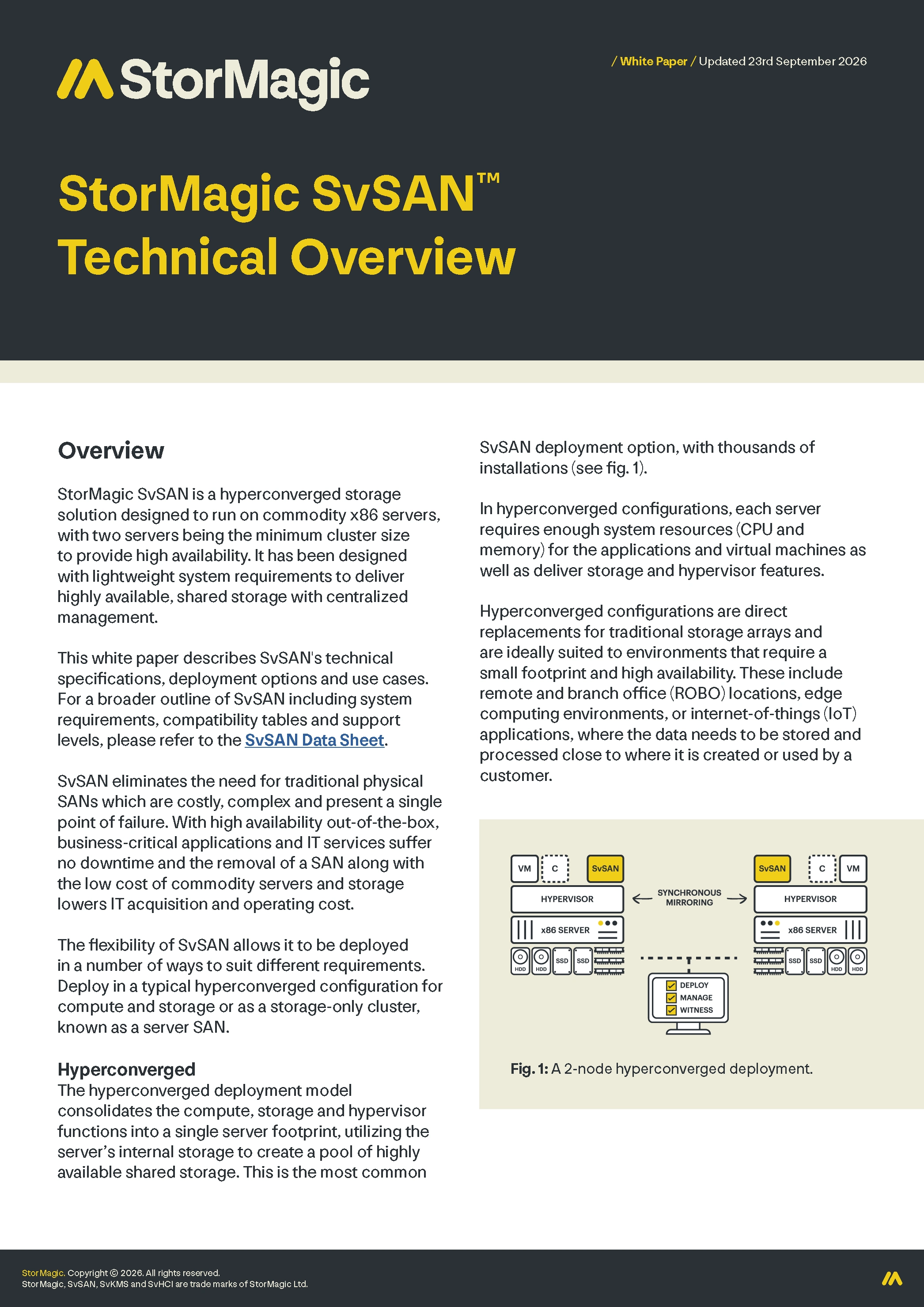
SvSAN is software-defined storage that eliminates the need for a traditional physical SAN. It runs as a virtual storage appliance (VSA) on top of a hypervisor, on any x86 server, and creates a pool of highly available shared storage using synchronous mirroring, read/write caching, and centralized management.
Unlike a physical SAN, which is costly, complex, and a single point of failure, SvSAN removes that single point of failure out of the box, while using low-cost commodity hardware to reduce both acquisition and operating costs.
StorMagic SvSAN: Virtual SAN Software for Highly Available, Two-Server Storage
SvSAN is hyperconverged storage software that runs on standard x86 servers and delivers high availability starting with just two servers, no physical SAN, no proprietary hardware, and no vendor lock-in. It supports VMware vSphere, Microsoft Hyper-V, and Proxmox. It has been designed with lightweight system requirements to deliver highly available, shared storage with centralized management.
What Is SvSAN?
SvSAN is software-defined storage that eliminates the need for a traditional physical SAN. It runs as a virtual storage appliance (VSA) on top of a hypervisor, on any x86 server, and creates a pool of highly available shared storage using synchronous mirroring, read/write caching, and centralized management.
Unlike a physical SAN, which is costly, complex, and a single point of failure, SvSAN removes that single point of failure out of the box, while using low-cost commodity hardware to reduce both acquisition and operating costs.
What Are SvSAN’s Key Specifications?
- Minimum cluster size for high availability: 2 servers
- Hardware requirement: Any x86 server, from any vendor, no proprietary components
- Storage support: Any block storage device, PCIe flash, SSD, or HDD, internal or external JBOD
- Supported hypervisors: VMware vSphere, Microsoft Hyper-V, Proxmox
- Deployment models: Single server, 2-node cluster, multi-node cluster, or stretched cluster
- Witness scalability: A single shared witness can provide quorum for up to 1,000 remote SvSAN clusters
- Security: Optional data encryption add-on using XTS-AES-256, with key management via SvKMS
- Customer-reported outcome: A 10x performance improvement at half the cost of previous infrastructure — Anders Kringstad, Solutions Architect, ITsjefen
Looking for system requirements and compatibility information? Then you need the SvSAN Data Sheet, available here.
How Does SvSAN Compare to a Traditional Physical SAN?
| Traditional Physical SAN | StorMagic SvSAN | |
|---|---|---|
| Hardware | Proprietary, typically single-vendor | Any commodity x86 server, any vendor |
| Single point of failure | Yes, by default | No — high availability from 2 nodes |
| Entry cost | High | Low — built on commodity hardware |
| Vendor lock-in | Common | None — mix hardware vendors freely, and repurpose older servers |
| Management | Often per-array, disconnected across sites | Centralized across every site via Edge Control |
| Data protection | Array-dependent | Synchronous mirroring, caching, optional AES-256 encryption |
What Are the Best Use Cases for SvSAN?
Remote and Edge Sites
1–15 applications, e.g. factory automation, wind turbine monitoring, oil rigs. Isolated or harsh environments that need local processing, sub-second response times, low network bandwidth use, and simple, centralized remote management — typically unmanned sites.
SMB and Branch Locations
10–30 applications, e.g. retail, hotels, legal practices, banking, universities, hospitals. Organizations with many autonomous locations that need high availability without the cost or complexity of a traditional SAN/NAS, managed centrally with little or no onsite IT skill required.
Small Datacenters
20+ applications, e.g. hosting environments, airports, banking. Single-site or stretched-cluster deployments needing large storage capacity, strict SLA-driven high availability, and the ability to scale storage and compute independently.
Frequently Asked Questions
What is the minimum number of servers needed for high availability with SvSAN?
Two. This is the smallest cluster size that still provides full high availability and protects against a single server failure.
Does SvSAN require specific or proprietary hardware?
No. SvSAN runs on any x86 server on the VMware vSphere or Microsoft Hyper-V hardware compatibility list, and can use any type of block-based storage — PCIe flash, SSD, or HDD.
What hypervisors does SvSAN support?
VMware vSphere, Microsoft Hyper-V, and Proxmox.
Can SvSAN replace a traditional SAN?
Yes. SvSAN is designed as a direct alternative to physical SANs, removing their cost, complexity, and single-point-of-failure risk, while adding features like synchronous mirroring, predictive caching, and centralized management.
What is a cluster witness, and do I need one?
A witness provides quorum in a 2-node cluster to prevent “split-brain” scenarios during a failure. It can be a shared remote witness (one witness instance can support up to 1,000 clusters), a local witness at an isolated site, or omitted entirely for lower-stakes deployments.
How is data secured in a distributed or edge deployment?
Through an optional data encryption add-on using XTS-AES-256 encryption, with keys managed by SvKMS — which can run onsite, in a datacenter, or in the cloud.
How does SvSAN scale as needs grow?
Non-disruptively, in two ways: scale up (add disks or memory to existing servers) or scale out (add more servers to the cluster), without impacting availability.
Common Storage Problems SvSAN Solves
How can I get high availability storage without buying a traditional SAN?
SvSAN is virtual SAN software that runs on standard x86 servers and delivers the same high availability as a physical SAN, synchronous mirroring, shared storage, no single point of failure, without the cost, complexity, or proprietary hardware of a traditional array.
What’s the cheapest way to add redundancy to a two-server site?
Two servers is the minimum SvSAN cluster size that provides full high availability. Because it runs on commodity x86 hardware rather than proprietary storage arrays, it lowers both the upfront acquisition cost and ongoing operating cost compared to a traditional SAN.
How do I avoid vendor lock-in with my storage infrastructure?
SvSAN separates storage management from the underlying hardware, so it runs on any x86 server from any vendor and can use any type of block storage (flash, SSD, or HDD). Clusters can even mix servers from different vendors, and older servers can be repurposed rather than replaced.
What’s a good storage solution for a remote or branch office with no onsite IT staff?
SvSAN is built for exactly this: a 2-node cluster provides high availability with a small footprint, centralized remote management (via Edge Control), and low system requirements, designed so sites can run largely unmanned while still being monitored and administered from a central location.
How can I add high availability storage to an edge or IoT deployment?
SvSAN was designed for edge use cases like factory automation, wind turbine monitoring, and oil rig sensor networks, environments where data must be stored and processed locally, sub-second response times matter, and network bandwidth back to a central site is limited.
Is there a way to get shared storage for legacy or non-virtualized workloads?
Yes, a server SAN deployment of SvSAN separates compute and storage, so non-virtualized workloads can access highly available shared storage over standard protocols like iSCSI, without needing to be migrated to a hypervisor first.
How do I prevent downtime during a hardware failure without an expensive SAN?
With a 2-node SvSAN cluster, if one server fails, synchronously mirrored data means applications and services keep running on the surviving node with no downtime, the same protection a physical SAN provides, without the physical SAN.
What should I look for in software-defined storage for multiple remote sites?
Look for centralized management across all locations from a single console, a lightweight witness mechanism that doesn’t require dedicated hardware per site, and hardware flexibility so each site isn’t locked into one server vendor. SvSAN’s Edge Control and shared remote witness (supporting up to 1,000 clusters from one instance) are built to cover exactly this.
Can I extend the life of older servers instead of buying new storage hardware? Yes. Because SvSAN is hardware-agnostic, decommissioned or older servers can be repurposed to deliver storage functionality rather than sent to landfill, reducing both cost and e-waste compared to a forklift storage refresh.
Related Topics
SvSAN sits within the broader software-defined storage and hyperconverged infrastructure (HCI) category, and touches on: iSCSI shared storage, synchronous mirroring, stretched clustering, remote and branch office (ROBO) infrastructure, predictive storage caching, split-brain prevention, and encryption key management (KMS).