It’s no secret that the AI market is booming. Organizations are investing billions each year in AI projects across every industry and use case, and the AI industry itself is projected to increase in value by around 9x by 2033.
But it’s data that makes it all possible. AI engines require massive amounts of data storage to produce effective models, learn, and keep improving. AI capabilities are almost always limited by data storage, making solving it an essential piece of the ever-expanding AI puzzle.
What is AI Storage?
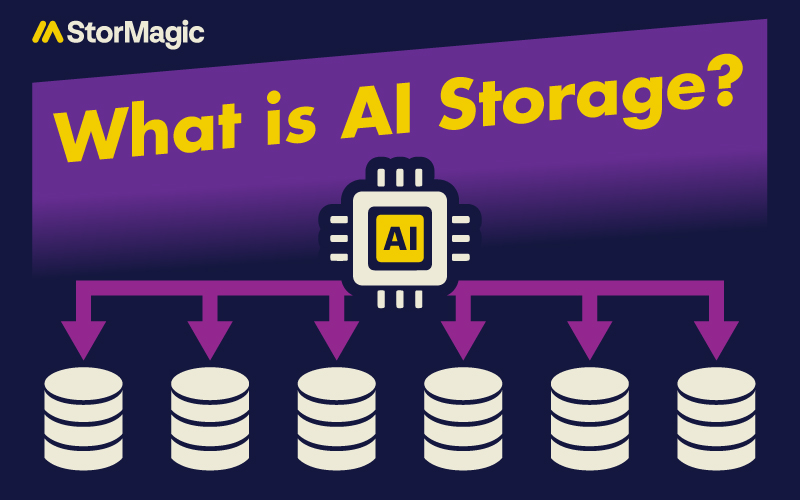
AI storage is specialized infrastructure that supports artificial intelligence (AI) and machine learning workloads. These are specialized data storage systems, both hardware and software, designed for AI’s demanding requirements.
AI storage delivers the capacity, performance, and flexibility AI-driven applications need. It’s what enables organizations to efficiently manage the large, complex datasets that power AI training, inference, and other critical processes.
We’re talking massive datasets, high-speed processing, and real-time analytics. AI storage systems are optimized for scalability, performance, and seamless integration with machine learning (ML) and deep learning (DL) workflows.
Traditional storage? It can’t keep up.
Data Storage Challenges in AI Storage
Legacy data infrastructure and traditional storage have difficulty managing the unprecedented amount of data created by AI workloads. If you’ve tried ChatGPT, you know it’s fast, ultra-responsive, and pulls from its hat several responses quicker than the fastest time a human can even type the alphabet (that’s 3.25 seconds, if you were wondering).
Legacy systems struggle with mixed media workloads, can’t deliver the fast data retrieval AI needs, and they’re often too complex to manage. Add energy-inefficient scaling to the mix, and power consumption spikes as AI demands grow. This is especially important to be aware of when features such as uptime and high availability are so important for today’s data storage requirements.
That’s why AI-native data platforms are emerging, purpose-built for the demands of AI innovation.
How AI Storage Differs from Traditional Storage
Traditional storage wasn’t built for what AI demands today. Here’s what sets AI storage apart.
- Data volume and variety: AI applications handle massive amounts of unstructured data, like images, videos, or sensor data. Traditional storage was designed primarily for structured data like databases and files.
- High performance: AI storage prioritizes high IOPS (input/output operations per second) and low latency to support real-time data processing. Traditional storage typically prioritizes cost or capacity over speed.
- Seamless integration: AI storage integrates with AI frameworks, as well as accelerators like GPUs and TPUs (tensor processing units). It’s purpose-built to work with the tools AI teams already use.
- Parallelism: AI systems process data simultaneously across distributed nodes, which demands advanced architectures like object storage or parallel file systems. Traditional storage wasn’t designed with this level of parallel processing in mind.
Examples of AI Storage by Industry and Use Case
AI Storage in Retail
AI, combined with video cameras and sensors on shelves, lets retailers better understand foot traffic in their stores and improve sales per square foot. The technology does so by identifying products that customers never linger near and recommending that the retailer replace them with more appealing goods. These capabilities require infrastructure that’s built for the demand of AI applications, not just traditional storage.
AI Storage in Manufacturing and Industrial Operations
Essential maintenance, quality control, and supply chain optimization applications require massive amounts of data. When managed by AI applications, this workload increases significantly. It’s fast, efficient, and offers competitively quick detection. If there’s a fault in the supply chain, AI can flag it immediately. This level of responsiveness requires AI storage capabilities that can keep up with the volume of data.
AI Storage in Healthcare
AI is more responsive to changing data storage requirements, for example, it can help to determine data accessibility requirements in healthcare environments. This is crucial as patient data accessibility becomes more important in our digital world.
Additionally, AI-enabled solutions can use machine learning algorithms and advanced analytics to analyze data usage patterns, optimize storage resources, and automate routine tasks. The result? Improved efficiency and real cost savings.
AI Storage in Finance
High-speed AI storage plays a key role in algorithmic trading, enabling rapid market analysis and seamless trade execution. This application lets financial institutions operate more securely, accurately, and efficiently, but it’s only enabled by the speed and resources of AI storage. Traditional data storage finds it difficult to keep up.
How Does AI Storage Work?
At a high level, AI storage works by using scalable architectures like object storage and parallel file systems to efficiently manage and distribute data across multiple storage nodes. This setup ensures that information is always accessible and can be processed simultaneously by AI systems, boosting speed and reliability.
To achieve high performance, AI storage relies on advanced technologies such as non-volatile memory express (NVMe) and solid-state drives (SSDs). These enable ultra-fast data retrieval, minimize latency during model training and inference, and support the high data transfer speeds essential for large-scale AI workloads.
Since not all data needs the same level of access, AI storage solutions often use a tiered approach. Frequently used data is kept on high-speed storage for quick access, while less critical information is moved to slower, more affordable storage tiers. This balance helps organizations manage costs without sacrificing performance.
As we discussed, AI storage has applications for almost an infinite number of AI use cases and applications (across almost any industry!) Therefore, the when, why, and how it works often varies. It’s also an ever-changing technology due to rapid innovation in the sector.
How is AI and AI Storage Reshaping Applications and IT Infrastructure?
In the developer world, more developers are now becoming prompt engineers. They’re creating AI applications in solo or small teams. These unique, new solutions are changing how industries operate and choose their tech stack.
Meanwhile, DevOps teams are increasingly relying on AI to manage efficiency. AI can manage infrastructure usage, helping them evaluate resource use. Artificial Intelligence for IT Operations (AIOps) can help them efficiently manage resources so they can reallocate infrastructure elsewhere. Essentially, it right-sizes how teams use their infrastructure – without them having to think about it.
Interested in these insights? Listen to PodMagic, Beyond the Buzz: What Real-World IT Teams Want from Infrastructure with Paul Nashawaty.