Edge AI is artificial intelligence (AI) that runs on hardware close to where data is created, like a store, a factory floor, or a remote site, instead of sending that data to a distant cloud server for processing. The AI model does its thinking locally. That means faster results, less dependence on an internet connection, and tighter control over sensitive data.
Edge AI, in short:
- It runs on local hardware, not in a distant cloud data center
- It processes data and makes decisions in real time, without waiting on an internet round trip
- It keeps sensitive data on-site instead of sending it to a third-party platform
- It keeps working even if the internet connection drops
That’s the short answer, but it’s worth walking through the fuller picture, along with some perspective from a recent PodMagic conversation we had on this exact topic.
How Does Edge AI Work?
Edge AI splits the AI process into two stages, and only one of them happens locally.
Training Happens Elsewhere, Usually in the Cloud
Building an AI model takes huge amounts of data and computing power, so most models are still trained on large cloud or data center systems, in a heavy-lifting step that typically only happens once or every so often as the model gets refreshed.
Inferencing Happens at the Edge
Once a model is trained, it gets deployed to hardware sitting at the edge location itself, whether that’s a small server in a store, a sensor on a factory line, or a compact box at a remote site. From there, the model does its actual job locally: analyzing a camera feed, reading a sensor, scoring a transaction, without sending that data anywhere first. Four things make this possible:
1. Local Compute, not Centralized Processing
Edge devices increasingly include hardware built for AI inferencing, such as graphics processing units (GPUs) or dedicated AI chips, packed into small, power-efficient form factors instead of full data center racks.
2. A Trained Model, Not Raw Training Data
The edge device only needs the finished model, not the massive dataset used to build it, which keeps hardware and storage requirements manageable.
3. Virtualized Infrastructure, Not Dedicated Hardware Per Workload
Many edge AI deployments run on virtualized infrastructure, like a two-node cluster, so the AI workload can run alongside other applications with built-in redundancy. This is not the only way edge AI deployments work, but is an ideal, and cost effective environment to do so.
4. Periodic Syncing, Not Constant Streaming
Instead of continuously sending raw data to the cloud, edge AI systems typically send only results, alerts, or model updates back to a central system, on whatever schedule connectivity allows. Put those pieces together and decisions get made in milliseconds, on-site, so the business keeps running even if the connection back to headquarters goes down.
Edge AI vs. Edge Computing: What’s the Difference?
Edge computing has been around for years, with businesses running workloads outside centralized data centers, whether that’s a two-node cluster running SvSAN at a bank branch or a server closet at a warehouse.
Edge AI is what happens when you add artificial intelligence to that picture. Instead of just running an application at the edge, you’re running an AI model there too, one that can analyze video, sensor data, or transaction patterns and make a decision in real time, without waiting on a round trip to the cloud.
Rahul Narsimhan, founder of Securicore and CEO of Hive Radar, put it simply on a recent episode of PodMagic, our podcast:
“The curveball that we have got right now is the integration of AI. I think people are coming to grasp, okay, what do I do with AI at the edge? And that’s where the challenge is going to be for the next little while.”
Rahul Narsimhan, Founder of Securicore, CEO of Hive Radar, The Future of Edge AI
Why Is Edge AI Important?
A few things have converged to push edge AI from a nice-to-have to something businesses are actively planning around:
Latency Still Matters
Edge AI enables businesses to process data closer to where it is generated, reducing the latency associated with sending information to and from the cloud.
Physics hasn’t changed, and data still takes time to travel to a cloud region and back; for some applications, even a few hundred milliseconds is too slow. In The Future of Edge AI & Portable Data Centers podcast, Narsimhan noted that even with satellite internet closing connectivity gaps, “there’s still latency,” and businesses running AI-driven decisions need answers faster than a round trip to the cloud allows.
Cloud Costs Stopped Feeling Predictable
Edge AI can help businesses gain greater control and predictability over the infrastructure costs associated with running AI workloads. For organizations running multiple AI workloads, balancing cloud infrastructure with on-premises and edge computing can therefore become an important consideration for managing costs and capacity.
During the podcast, Narsimhan described a shift many IT teams will recognize:
“There is a push to bring everything back in-house where you’ve got a little more predictability in pricing… but when you run multiple workloads, it’s not cheap. Now you add redundancy to it… the price goes right through the roof.”
Outages Have Consequences
Edge AI can provide businesses with a resilient alternative when cloud connectivity or cloud services become unavailable. A hybrid edge-and-cloud strategy can allow businesses to keep critical AI workloads running locally while continuing to use cloud infrastructure for workloads that benefit from centralized processing.
Cloud providers go down from time to time, and when they do, everything depending on them goes down too. Narsimhan pointed to recent Amazon and Azure outages that knocked out point-of-sale systems and smart devices alike, and argued the answer isn’t choosing cloud or edge:
“There could be a balance in terms of hybrid. You’ve got stuff in the cloud, but you’ve also got a backup plan which is the edge.”
Data Sovereignty Is a Growing Concern
Edge AI can help businesses keep sensitive and proprietary data closer to its source instead of sending it to third-party cloud AI platforms.
As more companies experiment with large language models, many are being told to keep proprietary data out of third-party platforms entirely.
“Companies will warn you, don’t put your proprietary code on any of these platforms to do the modeling,” Narsimhan said. “They say keep it local.”
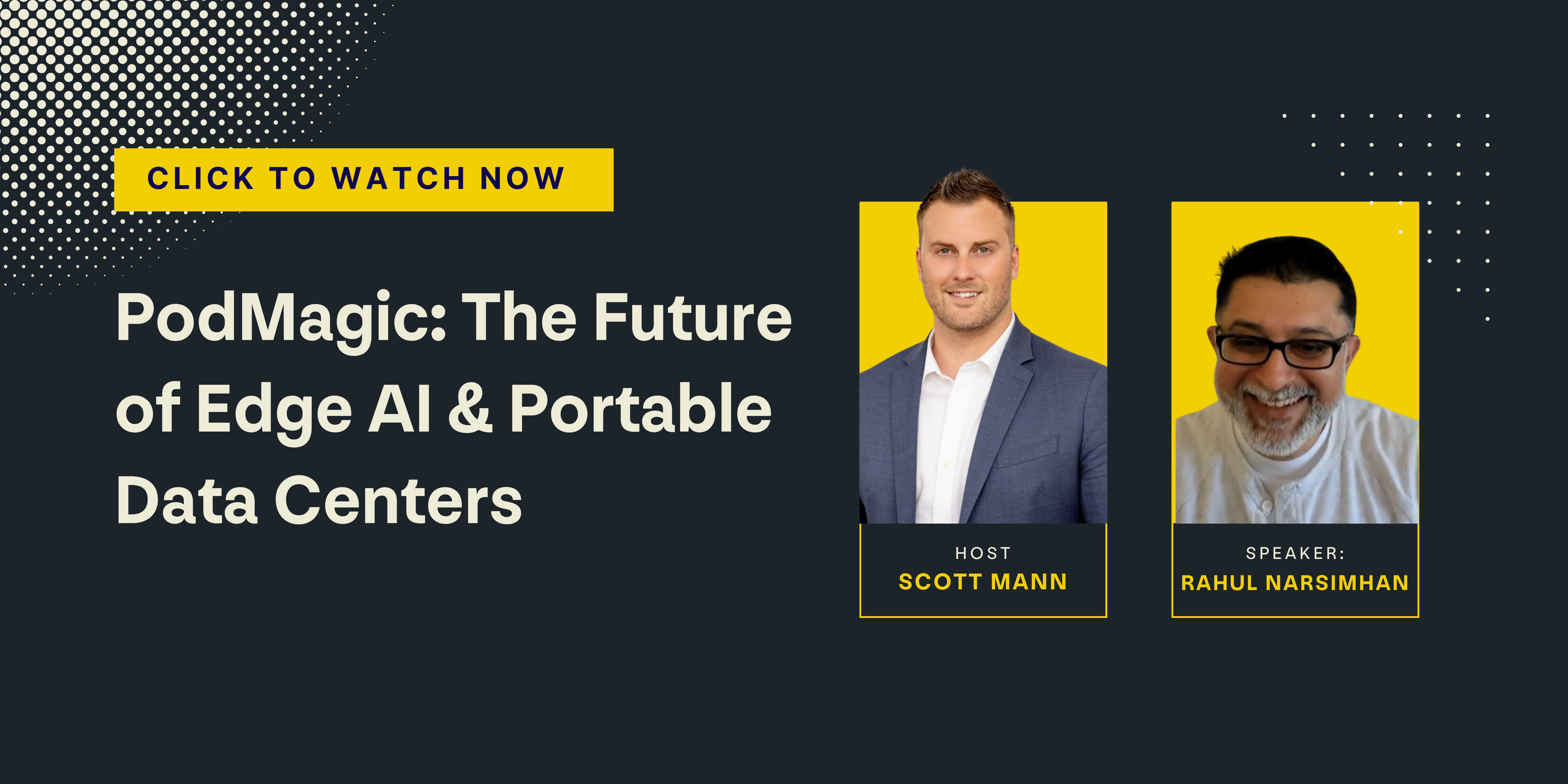
Interested in more of these insights? You can listen and watch the full episode of PodMagic, The Future of Edge AI & Portable Data Centers, here.
What Are Some Edge AI Use Cases?
Edge AI use cases span industries and environments where businesses need AI models to operate locally, reliably, and with limited dependence on cloud connectivity.
Picture this scenario: a retail chain with thousands of locations wants AI-powered loss prevention at every store. Shipping each site’s data to the cloud for analysis would be slow, expensive, and risky if connectivity drops. Running the AI model locally solves all three problems at once.
That’s just one example. Common edge AI applications already being explored or deployed include:
Remote Office/Branch Office (ROBO) Environments
Edge AI can support remote office and branch office (ROBO) environments by enabling AI inference and real-time decision-making at locations with limited or no dedicated IT support.
Typical applications include local inferencing for security cameras, access control, equipment monitoring, and other systems that need to operate reliably without continuously sending data to the cloud.
Education in Low-connectivity Regions
Edge AI can make AI-powered education more accessible in schools and communities where reliable internet connectivity is limited or unavailable.
An Example of Edge AI in Low Connectivity Regions
In our PodMagic conversation, Narsimhan described a project bringing full, AI-supported education systems to schools across Africa that run on solar power and stay online even when operating off-grid:
“Our reseller in Africa… (is) looking at schools, five hundred schools across Africa, where they’ve not got enough power, they depend on sunlight, (and) they want a full education system. If it requires to be run off grid, you can run that off grid. We are trying to make it more affordable.”
Field Research
Edge AI is particularly valuable for field research because it allows teams to analyze data locally in remote environments without relying on a constant connection to a central data center.
Isolated research teams running data analysis or biohazard monitoring in remote locations, with results synced back to a central lab whenever a connection is available.
Disaster Recovery
Edge AI can support disaster recovery by keeping critical business systems and AI workloads operational when cloud services or network connectivity are disrupted.
For example, a retail location could use local edge infrastructure to bring its point-of-sale system, and the AI tools running on top of it, back online within hours of a disruption instead of days.
Is Edge AI Only for Large Companies?
Edge AI is not limited to large enterprises or organizations with large IT budgets; advances in hardware, software, and deployment models are making edge AI increasingly accessible to businesses of all sizes.
A lot of people assume edge deployments are for defense contractors, mining operations, or companies with unlimited IT budgets.
“People think edge is complicated. Or only in places which are deployed by big guys… I think it’s available for everybody. That’s the biggest change I see.”
Rahul Narsimhan, Founder of Securicore, CEO of Hive Radar, The Future of Edge AI
The growing accessibility of edge AI follows a familiar technology adoption pattern, similar to the evolution of virtualization more than a decade ago. Like virtualization before it, edge AI can seem unfamiliar or overly complex until businesses see how the technology can be applied to a practical use case. Edge AI is having its own version of that moment today, unfamiliar until someone actually shows you what it looks like in practice.
Why Is Edge AI Complex to Deploy?
Edge AI can be relatively simple to deploy at a single location, but managing AI infrastructure consistently across dozens or hundreds of distributed sites is where deployment complexity increases.
Getting AI to run at a single edge site is straightforward enough. The harder part is keeping that consistent and manageable across dozens or hundreds of sites at once. Narsimhan described the layers involved: setting up virtual local area networks (VLANs), configuring firewalls, syncing storage clusters, and keeping every deployment consistent so a technician anywhere can recognize the setup instantly.
For distributed edge AI deployments, simplifying infrastructure management is therefore critical to making the technology practical and scalable. The goal isn’t to remove complexity; it’s to hide it behind something simple enough that a new hire can run it without months of training.
This emphasis on simplicity and centralized management is also a key principle behind hyperconverged infrastructure (HCI), which brings compute, storage, and other infrastructure resources together into a more manageable platform. For best practice edge AI deployment, businesses need to be able to manage the entire environment from one dashboard, whether that environment includes AI workloads or not.
How StorMagic Simplifies Edge AI Deployment
Edge AI doesn’t have to mean more moving parts for your team to manage. The complexity Narsimhan described, VLANs, firewalls, storage syncing, is still there under the hood. What changes is whether your team has to deal with it directly or whether it’s handled through infrastructure built to run consistently across every site, managed from one dashboard instead of pieced together one location at a time.
Common Questions About Edge AI
What is edge AI in simple terms?
Edge AI is artificial intelligence that processes data on local hardware, near where that data is generated, instead of sending it to a cloud server first. It’s what lets a device or system make a decision instantly, without waiting on an internet connection.
How is edge AI different from edge computing?
Edge computing describes running any workload outside a centralized data center. Edge AI specifically means running AI models at that same local hardware, so decisions like image recognition or anomaly detection happen on-site in real time.
What are some real examples of edge AI?
Common examples include in-store loss prevention, predictive maintenance on factory equipment, AI-assisted point-of-sale systems, and local data analysis for research teams working in remote or low-connectivity locations.
Do I need special hardware to run edge AI?
You need hardware capable of running AI inferencing locally, which increasingly includes compact, power-efficient systems built for edge sites rather than full data center racks. Compatibility depends on your specific workload, so it’s worth confirming hardware and software support before deploying.
Is edge AI more secure than cloud AI?
Edge AI can reduce certain risks by keeping sensitive data on-site rather than transmitting it to third-party platforms, which matters for organizations concerned about data sovereignty. It doesn’t eliminate security responsibilities. Local systems still need to be properly configured, monitored, and maintained.
Learn More About Edge AI with the StorMagic Podcast
This subject was explored in more depth in our StorMagic podcast, PodMagic, The Future of Edge AI & Portable Data Centers with Rahul Narsimhan (Hive Radar). Rahul shares how his company builds affordable, portable data centers for edge AI deployments, and why he thinks the biggest misconceptions about edge infrastructure are about to change fast.
Curious how SvHCI fits into an edge AI deployment? Visit the SvHCI product page for details.