AI is changing the retail industry by shifting from a tool that supports human decisions to a system capable of taking action on its own, known as agentic AI. This shift is reshaping personalization, inventory forecasting, and customer service, while also raising new questions about data visibility, security, and consumer trust.
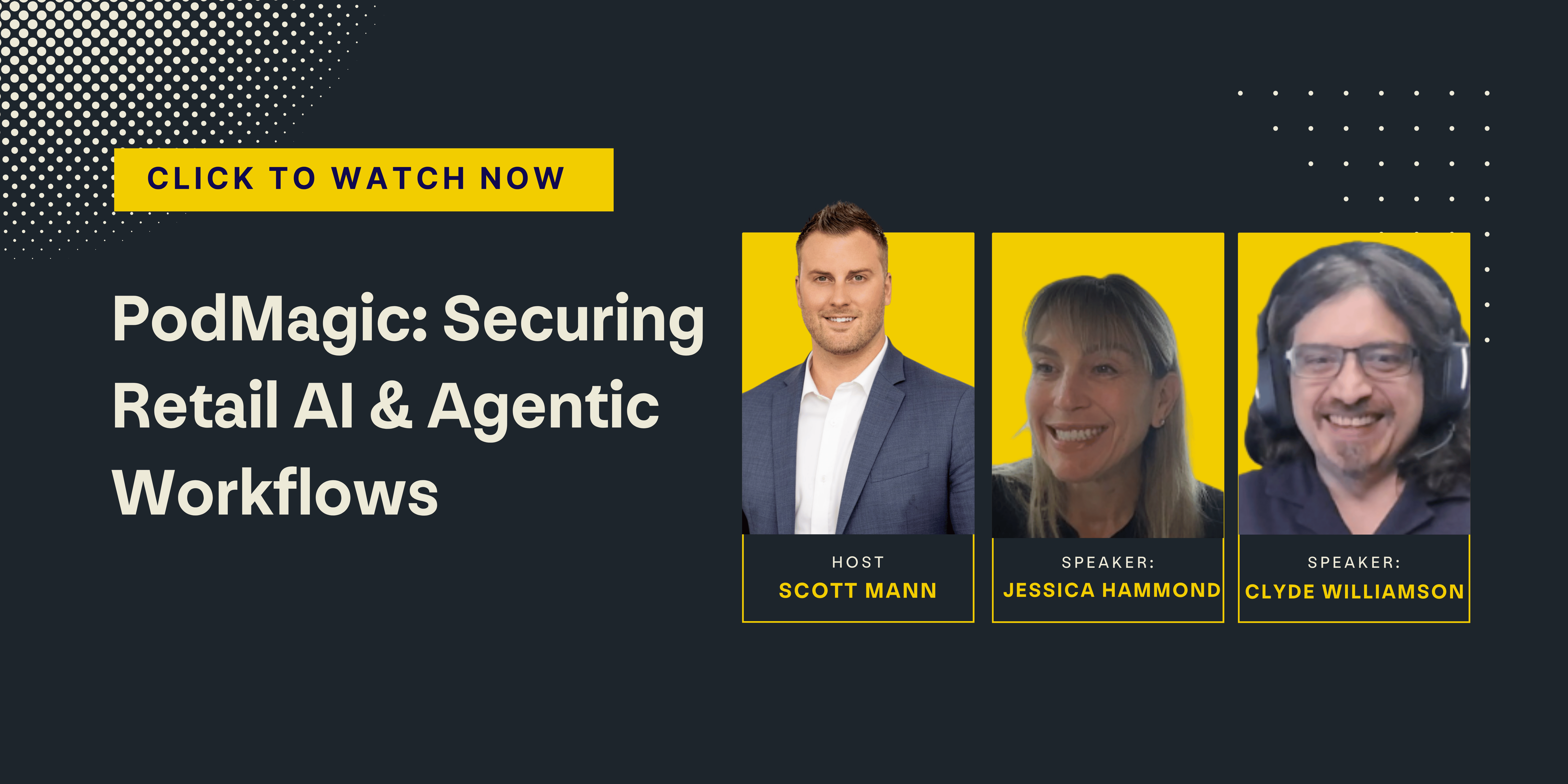
That shift creates real opportunity for retailers, along with new questions about how to manage customer data responsibly as AI takes on a bigger role. These are exactly the questions StorMagic’s Scott Mann explored with Clyde Williamson and Jessica Hammond of Protegrity in the latest episode of PodMagic.
In this blog, we cover what’s changed, what’s driving that change, the security practices retailers need to consider when deploying AI agents, and why more organizations are turning to sovereign AI to manage cost and risk.
Key AI Use Cases in Retail Today
A few use cases are driving most of the momentum in retail AI right now:
Personalization and Recommendations
Matching products, offers, or content to individual shoppers based on past behavior.
Demand Forecasting and Inventory Management
Predicting what customers will buy and when, to reduce stockouts and overstock.
Agentic Customer Service
Handling support requests, order changes, and returns with less manual intervention.
Operational Automation
Applying agentic workflows to tasks that used to require multiple manual handoffs across teams.
Each of these depends on the same underlying resource: customer and operational data. That’s where the conversation gets more complicated.
Our podcast episode, Securing Retail AI & Agentic Workflows with Clyde Williamson & Jessica Hammond, explores this topic in-depth. Listen to or watch the full episode for free, here.
The Data Visibility Challenge in Retail
Retailers generate an enormous amount of data, but knowing where it all lives is a separate challenge entirely. Security teams often can’t say with full confidence where sensitive customer data resides across their systems. Names, phone numbers, and payment details tend to spread out over years of operations, and if a security team cannot see that data, it’s difficult to protect.
This point came up directly in the latest StorMagic podcast episode, Securing Retail AI & Agentic Workflows with Clyde Williamson & Jessica Hammond, where Clyde described how, even years into working with retail organizations on data protection, “where is the data?” remains one of the most common responses he still hears from customers. Jessica added a specific angle on this too, tied to why fragmented data creates problems that go well beyond simple record-keeping.
Adding AI agents into the mix raises the stakes further. Any data a human employee could locate, an agent can likely locate too, which means visibility gaps that used to be a background risk become a more immediate one.
What Is Agentic AI in Retail?
Retail’s use of AI didn’t start with agents. Personalization, dynamic pricing, and demand forecasting have been standard for years. What’s changing now is the move toward agentic AI. Agentic AI in retail is systems that don’t just suggest an action but complete it, often across multiple tools and platforms, without a person approving every step.
Picture an AI agent that doesn’t just flag a customer service ticket. It resolves it, updates the order, and issues a refund in the same conversation. That’s the direction customer service and store operations are heading, and it changes what those roles actually look like day to day.
Why Data-centric Security Matters More Now
Data-centric security protects information directly, rather than relying on network boundaries to keep threats out. As AI agents take on more autonomous tasks in retail, this approach is becoming essential.
Traditional, perimeter-based security assumes that keeping unauthorized users out of the network is enough to keep data safe. That model works reasonably well when humans are the only ones accessing systems, following predictable, permission-based paths. It starts to break down once AI agents enter the picture. Agents often operate with broad system access, make their own decisions about how to complete a task, and can move through multiple systems in ways that are harder to predict or fully audit in advance.
Data-centric security addresses this by protecting information at the point of collection and keeping it protected as it moves, rather than only securing the systems around it.
How Retail Data-centric Security Works
Encryption at Collection
Sensitive data, such as payment details or personal information, is encrypted the moment it’s captured, before it moves anywhere else in the organization.
Tokenization for Analytics and AI Use Cases
Replacing sensitive values with consistent, linkable tokens allows retailers to run analytics, personalization, and AI models without exposing the underlying raw data.
Selective Decryption
Data is only unprotected at the specific point where it’s genuinely needed, such as a customer-facing report or a specific application function, rather than by default across every system it touches.
Protection that Travels with the Data
Whether data moves through an ETL pipeline, into a data warehouse, or to an AI model for inference, the same protection standard applies regardless of destination.
This approach matters for retailers because it narrows the number of places where sensitive data is ever fully exposed. Instead of trying to secure every system an AI agent might touch, retailers can focus on the smaller number of points where data is actually decrypted or accessed in its raw form, making both monitoring and risk assessment more manageable.
How to Deploy AI Agents for Online Retail Safely
For retailers exploring how to deploy AI agents for online retail, a few practices can help reduce risk from the start:
- Give each agent its own identity: Avoid letting agents simply inherit a human user’s permissions by default.
- Scope permissions narrowly: Grant access to only the data and systems an agent needs for its specific task.
- Audit the tools and skills behind each agent: The prompts, plugins, and skills an agent relies on deserve the same scrutiny as the agent itself.
- Protect data at the point of collection: Encrypt or tokenize sensitive data as soon as it enters your systems, rather than only protecting it in storage.
Monitor continuously, not just at launch: Agent behavior can shift as workflows evolve, so ongoing oversight matters as much as initial setup.
In our podcast episode, Securing Retail AI & Agentic Workflows with Clyde Williamson & Jessica Hammond, Clyde shared a personal example during the episode about vetting a third-party AI skill before using it himself, and what he found raised exactly the kind of concerns these five practices are designed to catch. It’s a good illustration of why step three on this list matters as much as it does.
Should You Treat AI Agents Like Employees?
One idea worth considering: retailers may benefit from treating each AI agent similarly to a new hire. That means assigning a distinct identity, clearly scoped permissions, and ongoing monitoring, rather than assuming an agent should inherit whatever access its human user already has.
This reframe changes how teams think about risk. An agent isn’t only a tool carrying out a command. It’s making its own choices about how to complete a task, which means the tools and permissions behind it are worth just as much attention as the agent itself.
What’s Next for AI in Retail?
Agentic AI is expected to expand well beyond customer service into broader retail operations over the next few years, covering areas like supply chain coordination, loss prevention, and workforce scheduling. Retailers that build strong data visibility and governance practices now will be better positioned to scale AI across more of the business later, with fewer surprises along the way.
One trend worth watching closely is the shift toward sovereign AI.
Why Sovereign AI in Retail is a Growing Trend
Sovereign AI refers to running AI models on infrastructure an organization controls directly, rather than relying entirely on public cloud providers. It’s gaining attention in retail for two main reasons: cost and data privacy.
Running everything through public cloud AI models comes with two costs that add up quickly: the literal cost of tokens, and the less visible cost of sending business and customer data to a third party. Clyde Williamson summed up both concerns directly in the StorMagic podcast episode, stating that “AI is expensive when you look at tokens” and that “AI is risky because you’re sending all of your business information and business knowledge off to some third party and crossing your fingers that they aren’t training their models on it or using it later to be a competitor against you.”
For retailers processing high volumes of transactions and customer interactions, token costs alone can climb fast. Sovereign AI takes a different approach: instead of sending every query to a large model hosted elsewhere, retailers run smaller models on their own infrastructure, on-premises or at the edge, to handle initial inferencing. Only when a task genuinely requires deeper reasoning does the system escalate to a larger model.
This approach connects to a broader concept retailers are increasingly factoring into their AI strategy: data sovereignty, or the idea that data should remain subject to the laws and governance of the location and organization where it’s collected. As retail AI adoption grows, particularly for organizations operating across multiple countries or regions with different privacy regulations, sovereign AI and data sovereignty are becoming closely linked considerations. For a closer look at what data sovereignty means and why it matters, see our guide: A Guide to the Sovereign Edge.
Want the Full Conversation?
This post only covers part of the discussion. In the full episode of PodMagic, Clyde Williamson (Senior Product Security Architect, Protegrity) and Jessica Hammond (Senior Director of Product Management for Gen AI, Protegrity) go further with StorMagic’s Scott Mann on data-centric security, a real-world example of an AI hiring tool that ran into trouble, and practical advice for retail leaders preparing their organizations for what comes next. Listen to the full episode: Securing Retail AI & Agentic Workflows with Clyde Williamson & Jessica Hammond.